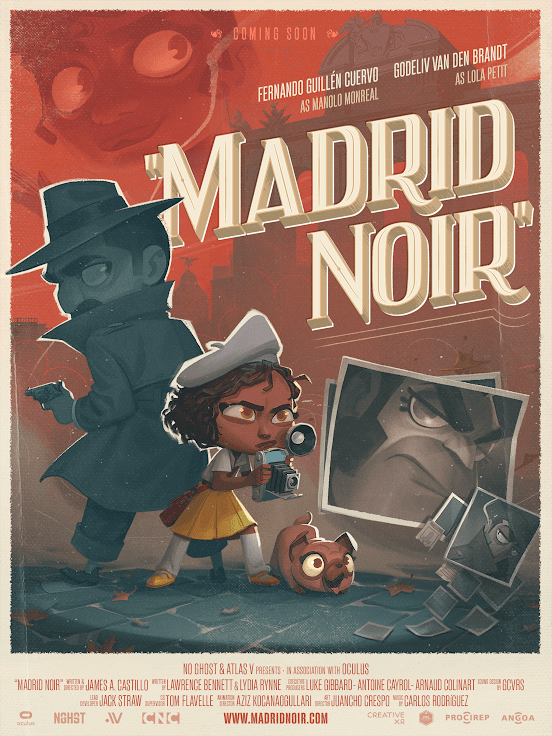
Set in 1950 and 1935, Madrid Noir tells the story of a young girl’s memories of her recently deceased uncle, who she suspects was a criminal, even a murderer. The narrative, more of a first person journal type memory, takes place mostly inside of Lola’s uncle’s house in Madrid, Spain.
After the prologue, which consists of some hand controller interaction where you must open an envelope, then select your hand skin color, then enter a room with an 8mm movie projector. You are asked to pick up a reel of film and thread it into the projector (it snaps into place) and then you press start. We watch a black and white video prologue before the main narrative starts.
I did not enjoy having to do so much useless action before getting to the story but I see how they are trying to engage and put you in the story from the get go.
Now we are in a house in the year 1950. Lola begins to go through her uncle’s things, and you are able to go through some of his things as well. You can open various drawers and pick up things like a pen, notepad, book, pipe, matches, etc. out of these drawers. Lola tells you a bit about her uncle before you are forced to search through the drawers to find a specific object – a bowtie – which starts the memory of Lola’s youth spent in this very same house years ago in 1935.
Lola was a young child obsessed with Sherlock Holmes. When she arrived in Spain, her uncle started acting suspicious. He sneaks out every night when he thinks Lola has gone to bed. As his behavior gets more and more erratic, she starts to suspect him of being up to no good. One day, he comes home with a large bag stuffed with cash, and this prompts Lola and her little puppy to follow her uncle into the night.
There are a couple of times where Lola stops talking to you and instead, you become Lola. There are moments when she tells you something like this, “I used to take pictures of him when he snuck out at night” and then you are Lola, able to take pictures with a camera in the VR environment.
I found most of this kind of switching between first person memory style story to second person, where you are Lola doing the things she is doing, to really take me out of the narrative as opposed to enhancing it through interaction. But I already philosophically believe that stories are interactive, even if I am not virtually touching something, clicking something, or moving an object around. Stories engage us.
What I did really enjoy was when we are given a flashlight to shine around onto the scene. I enjoyed this mechanical interaction because there is true freedom, not a sort of forced freedom where you have to dig in a draw to find a bow to trigger a memory, or pick up a phone and hand it to Lola so that she can talk to her mother. These are forced story points, where they make you interact, but when you have a flashlight or camera, you really are free to do what you like. The decision on where to point the light is your own decision. So it is kind of fun to explore the space.
Even though this story is 360 degrees, most of the story takes place in front of you. To edit, they do always have to fade to black, either on one picture in front of you, or fading the entire scene. Traditional editing is not a friend to 360 degree videos.
The story is engaging. Young Lola follows her uncle and sees some of the criminal activities. Then back in 1950, Lola discovers her camera with an unprocessed roll of film. You help Lola process this film (another moment of forced interaction, which I am not a fan of), but together, you find a photo that triggers a story told from her Uncle.
I’m not going to go into what you find out because that is part of the fun. The story does end with a cliffhanger that sets up a part two, even though I’m not sure if there is enough material for a part two as a VR story, but maybe if they moved it to a different medium like comics, where it would be easier to introduce some new characters and have a new mystery to solve.
I like the mystery detective type format. It works well for this story.
Technical Specs:
360 Degrees – you can look all around you
3DoF (3 Degrees of Freedom) – you cannot walk around in the space
3D Animation – you are in a 3-D animated environment
Limited hand controller interaction – you are able to interact with objects like a flashlight, camera, and can open drawers and pick up objects in the draws
 Mindweird
Leave a Reply